[[{"type":"media","view_mode":"media_large","fid":"8862","attributes":{"class":"media-image wp-image-12706","typeof":"foaf:Image","style":"","width":"291","height":"368","alt":""}}]] Gaius Musonius Rufus
The following historical facts evince the plight of philosophers like Musonius Rufus under the reign of despots. Gaius Musonius Rufus was born in 30 CE and died in 100 CE. In circa 60 CE, Musonius Rufus was sent into exile in Asia Minor by Nero, who had become an emperor then. In 62 CE, Musonius returns to Rome and in the same year Seneca loses his position as Nero’s advisor. In 65 CE again Musonius was exiled to Gyara. The conspiracy of Piso against Nero pushes Seneca to commit suicide.
In 68 CE, Nero is deposed and commits suicide. Galba becomes the Emperor and Musonius returns to Rome. During 68-69 CE, Epictetus studies with Rufus. 69 CE happened to be the year of four emperors [Galba, Otha, Vitellius and Vespasian]. In 70 CE, Musonius is again exiled. After 79 CE, he returns to Rome, once again. In 89 CE, Domitian banishes philosophers from Rome and Musonius finally dies in 100 CE.
It is quite surprising to know how Musonius constantly maintained his calm, power of mental and physical endurance in such trying circumstances under the rule of such callous and despot emperors.
It is a fact that Nero, the tyrant, was hostile to philosophers for he thought that the philosophers practised divination and as an emperor he didn’t like people who tried to figure out a future without him. So, he expelled philosophers from his kingdom. Musonius Rufus’ imprisonment and exile to the waterless island of Gyara is mentioned in “Life of Apollonius of Tyana” (by Philostratus). Further, it is recorded that he discovered a spring in that waterless island and people would go there to see him and the spring.
The same book has recorded that once, Demetrius, the philosopher met Musonius Rufus at the Istmus of Corinth, there he saw Rufus in chains and digging with a mattock to help to build a canal. Demetrius offered his usual greetings. Then, Musonius vigorously struck the mattock on the ground, lifted his head and asked “Do I upset you Demetrius, to see me digging in Istmus for Greece? I wonder what you would have thought if you saw me playing citara like Nero?” And this was Musonius Rufus, such was his Stioc sprit.
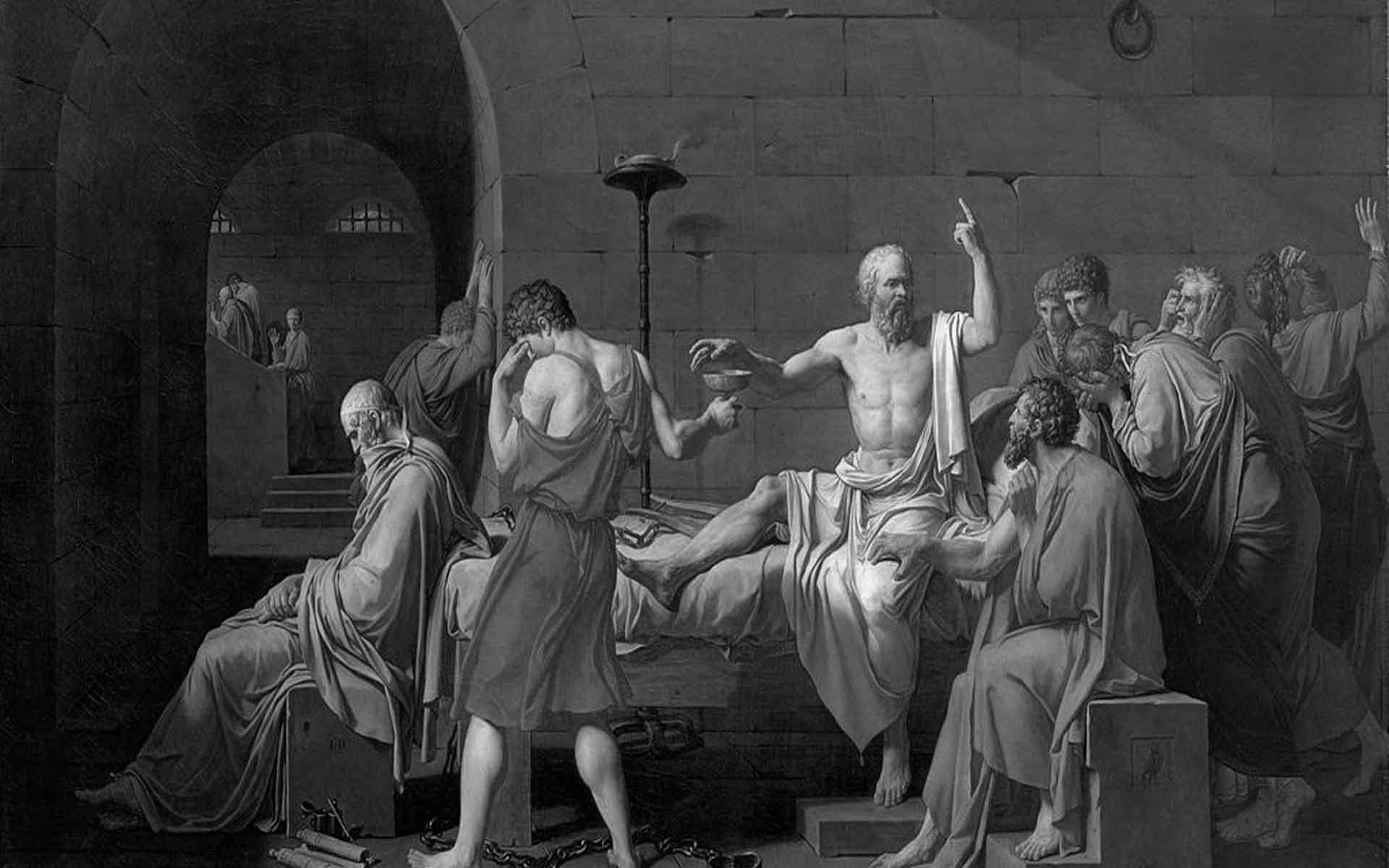
Musonius Rufus’ preoccupation on various subjects like necessity of the study of philosophy to men, women and kings, equal education for sons and daughters, marriage, sex, family life, bringing up children, and the art of growing old gracefully, accepting plights like exiles calmly, and homosexuality are worth examining. It is surprising that this man, who lived two thousand years ago under the rule of so many despots could think so freely, courageously, with the intuition of a philosopher, insight of a psychologist and compassion of a humanitarian, yet with Stoic insistence on reasoning and virtue. He was greatly influenced by the life and thoughts of Socrates as is evinced in his sayings.
Musonius’ views on homosexuality was rampant in Rome, at a time when there was a strict censure on the affluent, powerful people in the society. In the present situation of our modern society, where gay and lesbian relationships and even marriages are being legalised in many countries, Musonius’ views seem to be too orthodox, prejudiced or seem to lack the understanding of psychological necessity of a few peculiar men and women. Thus, many may not agree with his views. Though some of Musonius’ thoughts seem to be influenced by those of Plato, Musonius totally differs from Plato’s views on marriage, family and upbringing of children. Plato maintained that women are by right to be the virtual equals of men(W.M.Peppert Mantque). Plato’s philosophy of sex, his attack on family, his advocacy of eugenics and defense of women’s rights are not found in Musonius Rufus’ teachings. Though the girl shall have the same intellectual opportunities as the boy, the same chances to rise to the highest positions in the state, there will be no sex barriers in the community. Through the passage of time, Plato’s ideas of a eugenic society and the community living must have totally failed. Thus by the time of Musonius Rufus, we see that he extols the concept of family and advocates the age old system of marriage, parental care, and upbringing of children. [Socrates-469-399 BC] [Plato circa. 429-347 BCE, Musonius Rufus 30-100 CE].
Some thoughts compiled from Musonius Rufus’ lectures:
Musonius often substantiates his sayings with practical examples. Should we use many arguments to prove one point? Musonius’s answer is “rather than seeking many proofs over each subject, we should seek practical and clear ones”. He clarifies his statement by giving example of two doctors. A doctor who treats the patients with too many drugs and fails to cure does not deserve any praise. But one who helps the patients with a few drugs and cures them becomes noteworthy and deserves praise. In the same manner, a person (or a philosopher) who uses too many proofs to teach one point to the listener is not praiseworthy. Musonius opines that more intelligent the listener is, fewer the proofs he needs. A person who has a clear understanding of the subject he expounds, need not seek many proofs. Gods need no argument to prove anything because nothing is unclear or uncertain to them – such is Musonius’ opinion. When things are unclear and uncertain, arguments are necessary. Musonius opines that young people who are intelligent and better educated accept correct reasoning more easily, quickly and with a fewer arguments. He observes that there will be a lot of differences between a boy brought up in spartan manner and one brought up amid luxury and easy way of life. Of course, it is true that Musonius himself being a philosopher living nearly two thousand years ago in the Roman society under the rule of tyrants like Nero, advocates that the study of philosophy is essential to women too. Musonius’ statement not only elevates the status of women in a society, where they were treated inferior to men but throws light on the philosopher’s mind set, free and liberal. He says, Gods have endowed reasoning faculty to women and also to men, and this is a special gift to all human beings. He thus clarifies that women are psychologically on par with men. Secondly, the female also has the same senses as the male-seeing, hearing, ability to smell and the rest - women too are given the same type of sensory organs. They too desire for virtue and are naturally, disposed by nature to be pleased by noble deeds. If this is the case, Musonius asks” why would it be appropriate for men but not to women to seek to live honourably and consider how to do so, which is what studying philosophy is? Is it appropriate for men to be good but not for women?” Musonius, advocates his proposition logically. A woman, according to Musonius, must be able to manage an estate, to keep account of things beneficial to it and take charge of the household staff. It is quite a combination of a homemaker and a modern woman working in various institutions. The qualities Musonius recommends - rather techniques and the art of living can be perfected- as he says by the study of philosophy. Musonius says that Socrates used to quote to clarify the goal of philosopher, that is to investigate “what evil and good has been done in your halls” (verse from odyssey, Homer). Study of philosophy helps a woman also to practice self-control as it does men. The persons “who have studied philosophy exhibit the most beautiful character” and “the women who study philosophy will become a blameless partner in life”. Musonius states that a female philosopher would think it worse to do wrong than to be wronged and would also think suffering loss is better than taking more than one’s share. The study of philosophy imbibes in a woman as it does in man, a sense of ethical quality. He continues that “an educated woman will be braver than one untrained in philosophy”. Moreover, the study of philosophy strengthens her “not to submit to anything shameful as she is not afraid of death or pain, nor will she bow down before any powerful person or a despot”. Musonius expects that a woman thus trained will perform the biological functions of giving birth and to nurse them at her own breast without any hesitation. Here he points out the habit of women of his time, who were used to giving their children to the slaves to be breastfed (perhaps, not lose their fitness and beauty of their bodies). Musonius logically justifies his proposition that women should study philosophy for “the doctrine of the philosophers encourage a woman to be happy and to rely on herself”. Perhaps, such an education i.e., study of philosophy may equip modern women to achieve what is called work-life-balance.[[{"type":"media","view_mode":"media_large","fid":"8869","attributes":{"class":"media-image wp-image-12705","typeof":"foaf:Image","style":"","width":"435","height":"339","alt":""}}]] Image courtesy:- Google Image Search
Further Musonius stresses that daughters too should get the same education as that of sons. He makes it clear by the examples of training horses and dogs. “Those who train horses and dogs deal with males no differently from females. If one wants female horses to perform well the tasks of horses, they should not be trained differently than the males…”. This comparison at the first may seem to us crude, but it is based on fact. As such should there be difference in education and upbringing of male and female children?. In the modern world where women are working as technicians, pilots, scientists, teachers, officials ,astronauts, captains and commanders , we may understand the importance of Musonius’ views. He states that there is not one type of virtue for a man and another for a woman. Men and women have to live in accordance with justice. An unjust man would not be a good citizen and unjust woman would not manage her household well. Self control and courage are essential qualities needed for both men and women. As far as virtue is concerned, men and women should have the same kind of upbringing and education. But it doesn’t mean that a man should be spinning at home along with women and women should pursue gymnastics with men. Musonius advocates that we must start by teaching infants what is good and what is bad. We should teach them the same while educating concerning the most important thing in life. Musonius believes that no man would be properly educated without philosophy and no woman would be either,”women must develop good character and behave nobly since indeed philosophy is nothing but the practice of noble behaviour”.
Thus although Musonius advocates equal education etc, unlike Plato he upholds the concepts of family, marriage and upbringing children by parents.
Which is more important-essential-in leading a virtuous life theory or practice? Musonius answers this -
“while theory teaches what we ought to do, practice is demonstrated by those who have seen to act in accordance with the theory”.Musonius substantiates this with some illustrations. He explains the difference between being well-versed in theory and being quite efficient in practice. One doctor is capable of talking very well and very intelligently about the medical matters, but he has never actually cured or treated sick people. Another doctor is not capable of talking so intelligently or fluently about the medical matters, but is adept in his work, has experience of treating and healing the patients in accordance with the medical theory. Musonius asks ”which doctor do you choose or prefer when you are ill?”, decidedly the second one. The same statement holds good with sailors, pilots and musicians. So he sums up - although the theory behind action enabled one to speak fluently, it is the practice that enables one to act…practice is more important than theory because it more effectively leads humans to actions than theory does. Moreover, practice gives perfection to our actions that are the outcome of theory. [Theory is saying ‘do as is said’ and practice is ‘doing as I said’]. He is firm in his opinion that virtue is not a theoretical knowledge but it is also practical like both medical and musical knowledge. Practice, that is, vigorous training is needed to gain mastery and perfection in what we do Especially, a person who claims to be studying philosophy must practise it more diligently than a doctor or a musician. Since human beings are composite of body and soul, they should pay attention to train both. As a soul happens to be the better part, they should pay more attention in training it. Musonius says that people who attempt to study philosophy and pursue virtue need to practise it more. The first step in proper training of the soul is to become accustomed to recognise what is truly good and to be able to distinguish between seemingly good and seemingly bad. People who have taken part in philosophical discussions should realise that pain, death, poverty and such things which are free of wickedness are in no way evil, where as, wealth, pleasure and such things have no share in virtue or good. A person who practised to become a philosopher should not welcome pleasure and should avoid pain. He should not fear death either. As a staunch follower of the Stoics, Musonius maintains that pain must be regarded as having little importance. But, how can a person withstand or endure pain easily or be indifferent to pain? He says: to withstand pain easily, we suffer. It is useful to consider how people take much trouble to pursue some illicit love affairs and such things and suffer pain because of wicked passions. Is it not praiseworthy to suffer pain on account of virtue and noble character? Such pain should become endurable compared to pain suffered for petty and wicked reasons. People put up with many ills and hardships in pursuit of fame and gain. They endure any amount of pain and dishonour to acquire such petty things. If so, should it not be easy for people who try to acquire virtue to withstand pain? Musonius asks - is it not better to gain control over one’s own desire rather than to try to gain possession of someone else’s wife? Usually, it is strange that people who aim at better things are not more willing to endure severe pain than those who aim at petty or wicked things. Musonius’ words bring to my mind the physical and mental power of endurance of freedom fighters of our country as well as other countries. To them, pain and suffering were totally non-existent – they paid no heed to those. Musonius further says that if acrobats perform difficult and dangerous feasts such as somersaulting over knives etc for only a petty pay, shouldn’t we be willing to endure pain to gain some higher virtues and also complete happiness? If we consider the ability of some animals to endure pain, we may get some encouragement to bear pain. Cocks and quails without any knowledge about courage, virtue, beauty and justice, fight until death to avoid defeat. Humans should endure pain and become strong and regard pain as having little importance. Moreover, we know that no pain is intolerable for, by the time we say it, we would have already suffered it. To be concluded. Thanks to Arjun Bharadwaj for reviewing and editing this two-part essay. Thanks to Prem Madishetty, Sathya Saradhi Satwik, and Shanmukha Sai Saketh for their help in typing this essay.




Comments